


Scaffolding Materials Guide Types & Uses | NA Group
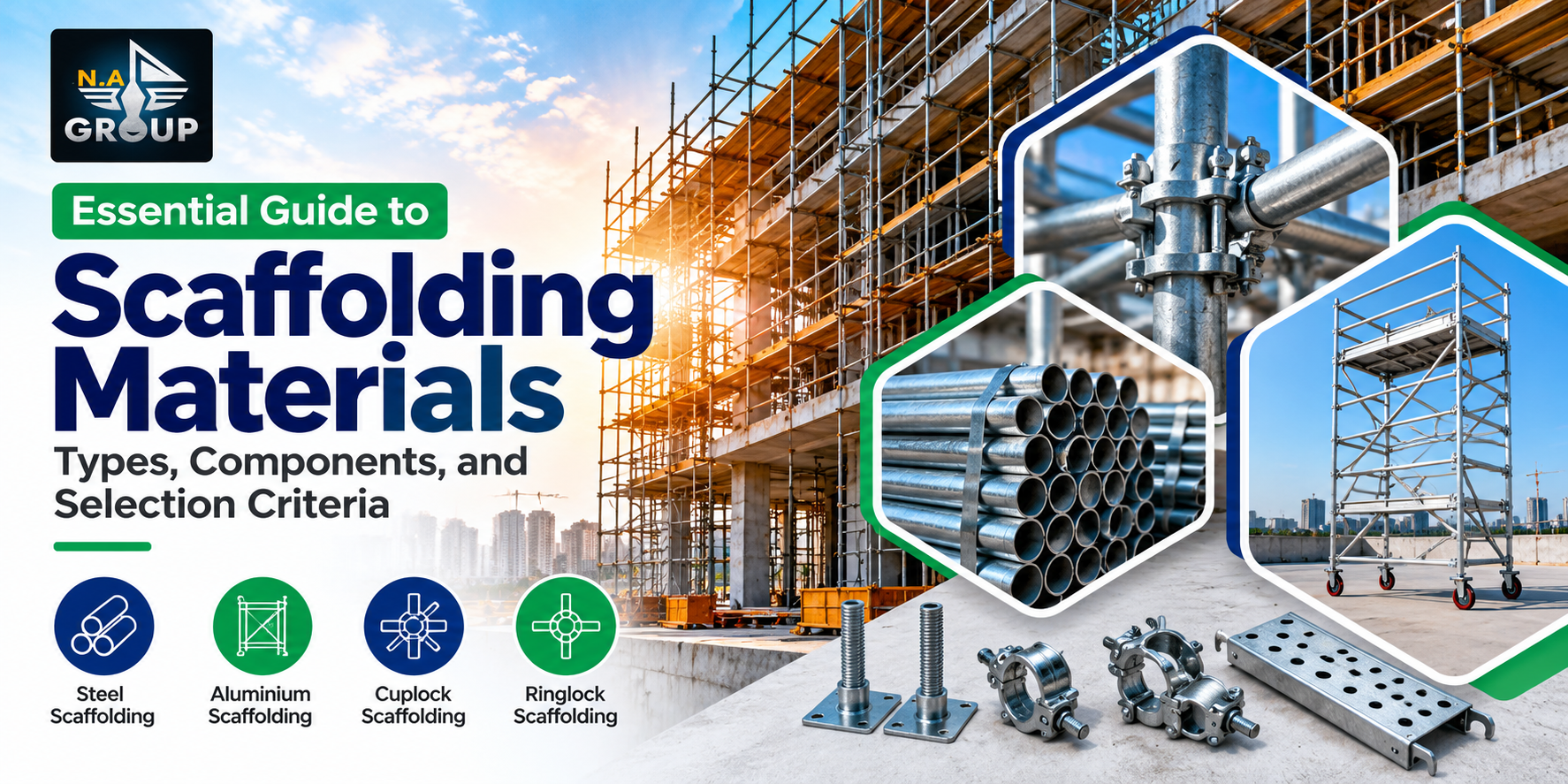
Scaffolding plays an important role in modern construction
by providing workers with safe and stable access to elevated work areas.
Whether it is a residential building, commercial complex, industrial facility,
or infrastructure project, selecting the right scaffolding materials helps
improve workplace safety, productivity, and project efficiency.
Choosing scaffolding involves understanding material
strength, load-bearing capacity, durability, environmental conditions, and
installation requirements.
In this guide, we explore different types of scaffolding
materials, essential components, popular scaffolding systems, and important
factors to consider when selecting the right solution.
1. Types of Scaffolding Materials: Steel vs. Aluminium
Steel and aluminium are two commonly used materials in
scaffolding systems. Each offers different advantages depending on project
requirements.
Steel Scaffolding
Steel scaffolding is widely used in construction and
industrial applications because of its strength, durability, and load-bearing
capacity.
Key Benefits:
- High
strength and load-bearing capacity.
- Suitable
for heavy-duty construction projects.
- Durable
and reusable.
- Provides
stability for large structures.
- Galvanized
finishes improve corrosion resistance.
Steel scaffolding is commonly used for commercial buildings,
industrial construction, concrete work, and infrastructure projects.
Aluminium Scaffolding
Aluminium scaffolding is a lightweight alternative suitable
for projects requiring easy transportation, quick installation, and flexible
access.
Key Benefits:
- Lightweight
and easy to transport.
- Faster
assembly and dismantling.
- Naturally
corrosion-resistant.
- Suitable
for indoor and outdoor maintenance.
- Ideal
for painting, electrical work, and repairs.
|
Parameter |
Steel Scaffolding |
Aluminium Scaffolding |
|
Weight |
Heavy |
Lightweight |
|
Strength |
Suitable for heavy-duty applications |
Suitable for designed access loads |
|
Mobility |
Less convenient to move |
Easy to reposition |
|
Corrosion Resistance |
Improved through galvanization |
Naturally corrosion-resistant |
|
Applications |
Construction and industrial projects |
Maintenance and finishing work |
The right material depends on project requirements, loading
conditions, and site accessibility.
2. Essential Scaffolding Components and Accessories
A scaffolding structure consists of interconnected
components that provide stability, support, and safe working access.
1. Standards (Vertical Members): Standards are
vertical tubes that transfer scaffolding loads towards the foundation and form
the main supporting framework.
2. Ledgers (Horizontal Members): Ledgers connect
vertical standards horizontally and maintain the structural arrangement of the
scaffolding.
3. Transoms: Transoms are horizontal members placed
across ledgers to support working platforms and distribute loads.
4. Base Plates and Adjustable Jacks: These components
provide a stable foundation and help distribute loads while allowing height
adjustments.
5. Couplers and Clamps: Couplers connect scaffolding
tubes. Common types include right-angle couplers, swivel couplers, and sleeve
couplers.
6. Scaffolding Planks and Platforms: These provide
working surfaces for construction workers. Steel platforms and other approved
materials with suitable anti-slip surfaces help support safe working
conditions.
3. Different Types of Scaffolding Systems
Selecting the right scaffolding system improves
accessibility and construction efficiency.
Cuplock Scaffolding
Cuplock scaffolding is a modular system that uses cup-shaped
locking mechanisms to connect vertical and horizontal members.
Applications:
- Residential
and commercial construction.
- Concrete
slab support.
- Industrial
maintenance.
- Infrastructure
projects.
Key Advantages:
- Modular
connection system.
- Faster
assembly and dismantling.
- Fewer
loose connection components.
- Suitable
for large construction projects.
NA Group provides MS Cuplock scaffolding rental and supply
solutions for construction requirements.
Ringlock Scaffolding
Ringlock scaffolding uses rosette-shaped connection points
to connect vertical standards, horizontal ledgers, and diagonal braces. Its
flexible connection arrangement makes it suitable for complex structures.
Applications:
- Industrial
facilities.
- Infrastructure
projects.
- Curved
structures.
- Commercial
construction and maintenance.
Key Advantages:
- Flexible
connection arrangements.
- Adaptable
to different structures.
- Modular
assembly.
- Suitable
for complex access requirements.
Aluminium Mobile Scaffolding Towers
Aluminium mobile scaffold towers provide lightweight and
movable access platforms. They typically include aluminium frames, platform
sections, stabilizers, and lockable castor wheels.
Applications:
- Interior
painting.
- Electrical
installation.
- Building
maintenance.
- Ceiling
work and cleaning.
Key Advantages:
- Lightweight
construction.
- Convenient
transportation.
- Quick
assembly.
- Easy
repositioning on suitable surfaces.
NA Group offers aluminium scaffold tower rental and supply
solutions for construction and maintenance applications.
4. Important Factors to Consider When Choosing
Scaffolding Materials
Selecting suitable scaffolding materials requires careful
consideration of the following factors:
Load-Bearing Capacity: Consider the number of
workers, construction materials, tools, and equipment that will be placed on
the platform. The scaffolding must be designed for the intended loads by a
competent professional.
Project Requirements: Residential construction may
require scaffolding for masonry and plastering, while commercial and industrial
projects may need specialized access solutions.
Environmental Conditions: Humid and coastal
environments can increase corrosion risks. Galvanized steel and suitable
aluminium products can help reduce corrosion-related maintenance.
Ground Conditions: Evaluate soil stability,
ground-bearing capacity, surface levels, and drainage. Appropriate base plates,
adjustable jacks, and sole boards should be selected according to site
conditions.
Installation Requirements: Consider assembly
complexity, project duration, and available skilled workers. Modular systems
such as Cuplock and Ringlock can improve assembly efficiency when installed by
trained personnel.
5. Scaffolding Safety Standards and Best Practices
Safety should always be a priority when selecting and using
scaffolding materials.
Follow these essential practices:
- Use
Quality Materials: Select components that meet applicable requirements
and avoid damaged or defective materials.
- Ensure
Proper Installation: Erect scaffolding according to approved designs
and configurations.
- Install
Guardrails and Toe Boards: Provide suitable edge protection wherever
required.
- Inspect
Before Use: Conduct regular inspections, particularly after
modifications or adverse weather conditions.
- Provide
Stable Foundations: Ensure proper ground support using suitable base
plates and foundation arrangements.
- Follow
Safety Regulations: Follow applicable Indian safety requirements and
relevant standards, including IS 2750 and IS 3696, wherever applicable.
Installation, alteration, and dismantling should always be
performed by trained and competent personnel.
6. Why Choose NA Group for Scaffolding Solutions in
Bangalore?
NA Group has been providing scaffolding and fabrication
solutions since 1983, serving residential, commercial, industrial, and
infrastructure projects.
With over 40 years of industry experience, the company
offers scaffolding manufacturing, rental, supply, and fabrication services.
Our Scaffolding Products and Services:
- MS
Cuplock Scaffolding Rental and Supply.
- MS
Scaffolding.
- Aluminium
Scaffold Tower Rental.
- Aluminium
Scaffolding Supply.
- MS
Fabrication Services.
- Aluminium
Fabrication Services.
- Centering
Sheets.
Why Work With NA Group?
- Over
40 years of industry experience.
- Quality-focused
scaffolding products.
- Experienced
workforce.
- Timely
delivery.
- Competitive
pricing.
- Customer-focused
support.
Whether you need scaffolding for residential construction,
commercial developments, or industrial projects, NA Group offers solutions
based on your requirements.
Looking for reliable scaffolding solutions in Bangalore?
Contact NA Group to discuss your project requirements.
NA GROUP – Scaffolding & Fabrication Solutions Since
1983
Website: https://nagroup.in/
Phone: +91 7406088809
Email: enquiry.nascaffolding@gmail.com
Address: 86/1, Thubarahalli, Ramagondanahalli, P.O. Varthur
Road, Bangalore – 560066.
Frequently Asked Questions (FAQs)
1. What are the main materials used in scaffolding?
Steel and aluminium are the two commonly used scaffolding
materials. Steel is suitable for heavy-duty construction, while aluminium is
preferred for lightweight access solutions.
2. Which is better: steel or aluminium scaffolding?
Steel offers high strength for demanding construction
applications, while aluminium provides lightweight handling and easy mobility.
The right choice depends on project requirements.
3. What is Cuplock scaffolding used for?
Cuplock scaffolding is commonly used for construction,
concrete support, building access, and industrial applications.
4. What are the advantages of aluminium scaffold towers?
Aluminium scaffold towers are lightweight, easy to
transport, and suitable for painting, electrical installation, and maintenance
work.
5. Where can I find scaffolding rental services in
Bangalore?
NA Group provides MS Cuplock scaffolding and aluminium
scaffold tower rental and supply services in Bangalore. Contact +91 7406088809
for enquiries.